What Causes Rubber Bands to Break and How to Prevent It
It is a small but universally frustrating experience: you stretch a rubber band around a stack of papers or a bag, and with a sudden, sharp “snap,” it breaks. This common moment of product failure can be more than just an annoyance; in a professional or industrial setting, a broken rubber band can lead to scattered products, disorganized information, and even a potential safety hazard. But why does this happen? What causes a seemingly strong and stretchy rubber band to suddenly fail? The reasons behind a rubber band breaking are a fascinating mix of material science, environmental factors, and user application.
Understanding the causes of failure is the first and most important step in preventing it. A key part of our mission at RuBands is not just to provide a product with superior durability, but also to educate our customers on how to get the most out of it. This guide will explore the primary reasons why rubber bands break and provide you with practical prevention tips to ensure a reliable and secure hold, every time.
The Science of Failure: Understanding the Weakest Link
A rubber band’s failure almost always begins at a single, microscopic point. It is very rare for the entire band to just give way at once. Instead, a tiny imperfection—a nick, a cut, a particle of impurity, or a point of chemical degradation—becomes a “stress concentration point.” When the band is stretched, the tension is no longer evenly distributed across its surface; it becomes highly concentrated at the tip of that tiny flaw. This concentrated stress can be many times higher than the overall tension in the rest of the band, and it is here that a micro-tear begins. Once started, this tear can “unzip” across the band in a fraction of a second, resulting in the sudden “snap.”
The key to preventing breakage, therefore, is to minimize the factors that can create these initial stress concentration points.
Cause 1: Environmental Degradation (The Invisible Enemy)
This is the most common cause of “spontaneous” breakage, where a band seems to snap with very little force. Over time, the long, flexible polymer chains that give rubber its elasticity are attacked and broken down by the environment.
- UV Radiation: This is the most aggressive culprit. Ultraviolet (UV) light from the sun or even from fluorescent office lighting is a powerful energy source that bombards the rubber and breaks the chemical bonds in the polymer chains. This process, called photodegradation, rapidly makes the rubber hard, brittle, and prone to cracking. A band left on a sunny windowsill will fail in a fraction of the time of one stored in a dark drawer.
– Oxidation and Ozone: Oxygen and ozone in the air are highly reactive and they attack the polymer chains, causing them to break. This chemical degradation also results in a loss of elasticity and strength. Heat acts as a catalyst for this process, which is why a rubber band left in a hot car will become weak and gummy.
Prevention Tips:
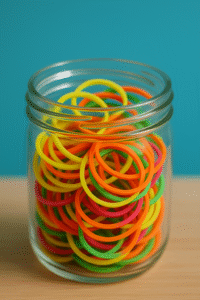
- Proper Storage is Crucial: The single best way to prevent this type of failure is through proper storage. Keep your main supply of rubber bands in a cool, dark, and sealed container (like a zip-top bag or a lidded tub) to protect them from light, air, and heat.
– Choose the Right Material for Outdoor Use: For any application that will involve long-term exposure to the outdoors, do *not* use a standard natural rubber band. You must use a specialized, UV-resistant synthetic rubber band, like our All-Weather EPDM bands, which are specifically engineered to withstand the elements.
Cause 2: Over-Stretching and Incorrect Sizing
This is the most common user-related cause of a rubber band breaking.
- Exceeding the Elongation Limit: Every rubber band has a maximum percentage it can be stretched before it fails, known as its “ultimate elongation.” If you try to stretch a small band around a very large object, you are simply asking the material to do more than it is physically capable of, and it will snap.
– Creating Excessive Tension: Even if you don’t stretch it to its absolute limit, using a band that is too small for the job creates a huge amount of internal stress. This high-tension state makes the band much more susceptible to failure from any minor surface nick or flaw.
Prevention Tips:
- Always Choose the Right Size: This is a critical aspect of preventing product failure. Follow a proper sizing guide. The ideal band should provide a snug and secure hold with a moderate amount of stretch. It should not be stretched to near its limit. If a band looks almost transparent and is stretched into a very thin line, it is under too much tension.
– When in Doubt, Go Up a Size: If you are unsure, it is always safer to choose a band that is a size larger and, if necessary, loop it around the object twice.
Cause 3: Physical Damage (Nicks and Cuts)
As we’ve learned, a tiny nick is the starting point for a catastrophic tear.
- The Cause: Stretching a rubber band over an object with a sharp corner, like the edge of a metal file or a piece of corrugated cardboard, can easily create a small cut on the band’s surface. A sharp fingernail can also cause this kind of damage.
– The Effect: This nick immediately becomes a massive stress concentration point. The next time the band is put under tension, it is highly likely to fail at that exact spot.
Prevention Tips:
- Be Mindful of Sharp Edges: When bundling items with sharp corners, try to soften the corner with a piece of scrap paper or cardboard before applying the band.
– Choose a Wider Band: For applications that involve contact with abrasive or sharp surfaces, a band with a wider cut is a much more durable choice. It has more surface area and is more resistant to the effects of a small nick.
The RuBands Advantage: A Foundation of Durability
The final and most important prevention tip is to start with a high-quality product. The superior durability of a RuBands product is a result of our manufacturing process, which is designed to combat these causes of failure from the very beginning. We use high-quality, long-chain polymer rubber for inherent tear resistance, and our advanced antioxidant package provides superior protection against environmental degradation. Choosing a quality product is the first and most important step in preventing breakage.
Conclusion: A Combination of Quality and Care
Preventing a rubber band from breaking is a partnership between the manufacturer and the user. We are committed to providing you with a product that is engineered for maximum durability. By following these simple prevention tips—storing them correctly, choosing the right size for the job, and being mindful of physical damage—you can ensure that you get the reliable, secure, and snap-free performance that our products are designed to deliver.