Why Some Rubber Bands Get Sticky Over Time: The Science of Degradation
It is one of the most unpleasant and perplexing of all office supply maladies. You open an old desk drawer or a long-forgotten storage box, and the handful of rubber bands you had stored inside have transformed into a single, sticky, semi-melted blob. These sticky rubber bands are not just a frustrating mess; they are a clear and visible sign of a fundamental process of chemical decay. This is a common and often-asked question: why does this happen? The answer lies deep in the molecular structure of the rubber itself and is a powerful lesson in the science of product aging and material degradation.
The good news is that this sticky fate is not inevitable. A high-quality, well-made rubber band can resist this process for many, many years. The tendency to become sticky is a direct indicator of a lower-quality product and can be significantly mitigated by proper storage. This guide will explore the scientific reasons behind why some rubber bands get sticky and provide you with the knowledge you need to prevent it from happening to your own supply.
The Core of the Issue: Polymer Chain Breakdown
To understand why a rubber band gets sticky, you have to think of it on a molecular level. A rubber band is a polymer, which means it is made of incredibly long, chain-like molecules (in the case of natural rubber, these are polyisoprene chains). In a fresh, new rubber band, these long chains are held together by a process called vulcanization, which creates strong “cross-links” between them. This creates a stable, solid, and elastic network. The stickiness is the result of this stable network breaking down.
The process of a solid turning back into a softer, gooier state is known as “reversion” or “devulcanization.” This is a form of material degradation where the long polymer chains, and sometimes the cross-links themselves, are broken into much shorter, less stable pieces. These shorter chains are not as well-anchored and can move more freely, which gives the material a softer, stickier, and more semi-liquid feel. The sticky residue you feel is the physical evidence of this molecular breakdown.
The Catalysts of Decay: The Enemies of Rubber
This process of degradation does not happen on its own. It is caused or dramatically accelerated by a number of environmental factors. The stickiness you observe is a sign that the rubber has been losing a long battle with these chemical enemies.
1. Oxygen: The Slow and Steady Attacker
The primary driver of this degradation is a process called oxidation. The oxygen molecules in the air are highly reactive, and they attack the chemical bonds within the rubber’s polymer chains, breaking them into smaller pieces. This is a very slow process at room temperature, but over a period of many years, it can cause the rubber to lose its integrity.
2. Heat: The Great Accelerator
Heat is the most significant catalyst in the creation of sticky rubber bands. Heat does not directly cause the degradation, but it dramatically speeds up the rate of the oxidation reaction. For every 10°C (18°F) increase in temperature, the rate of oxidation can roughly double. A box of rubber bands stored in a hot attic, a sunny warehouse, or the glove compartment of a car can undergo years’ worth of chemical decay in just a few short months. The heat provides the energy that the oxygen molecules need to break down the polymer chains much more quickly.
3. UV Light: A Powerful Destructive Force
While UV light is more known for making rubber brittle, it also contributes to the overall breakdown of the polymer structure, which can eventually lead to stickiness in some formulations, especially when combined with heat.
The RuBands Defense: How a Quality Product Resists Degradation
So, why do some bands succumb to this fate while high-quality bands remain stable for years? The difference lies in the science of the rubber compound itself.
- The Power of Antioxidants: This is the most crucial difference. A premium rubber band from RuBands is not just made of rubber and sulfur. Our proprietary compound is formulated with a powerful package of “antioxidant” chemicals. These are sacrificial molecules. Their job is to react with the oxygen molecules *before* the oxygen has a chance to attack the rubber’s polymer chains. They essentially act as bodyguards for the rubber, sacrificing themselves to protect the integrity of the material. A cheap rubber band will often have a minimal or non-existent antioxidant package, leaving it completely defenseless against the long-term attack of oxygen and heat.
– A Stable, Perfect Cure: The quality of the vulcanization process also plays a role. A well-cured rubber with a strong, uniform network of cross-links is inherently more stable and resistant to the reversion process.
Prevention: Your Role in the Process
While we build our bands to be exceptionally stable, you can play a critical role in ensuring their longevity with proper storage. The key to preventing sticky rubber bands is to control their environment.
- The Number One Rule: Keep Them Cool. Since heat is the great accelerator of this process, the most important of all storage tips is to keep your bands in a cool, temperature-stable environment. Never store them in a hot location.
– Keep Them in the Dark: Protecting them from UV light will also help to preserve their chemical integrity.
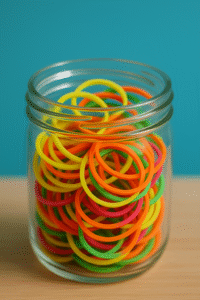
– Keep Them Sealed: Storing them in a sealed bag or container will reduce their exposure to the oxygen in the air.
Conclusion: A Sign of Inferior Quality
The phenomenon of sticky rubber bands is more than just a mess; it is a clear and visible sign of advanced material degradation. It is an indicator of a low-quality product that lacks the protective chemistry needed to ensure a long and stable life. By starting with a high-quality, professionally formulated product from RuBands and by following these simple storage tips, you can be confident that your rubber bands will remain strong, stretchy, and, most importantly, non-sticky for many years to come.